


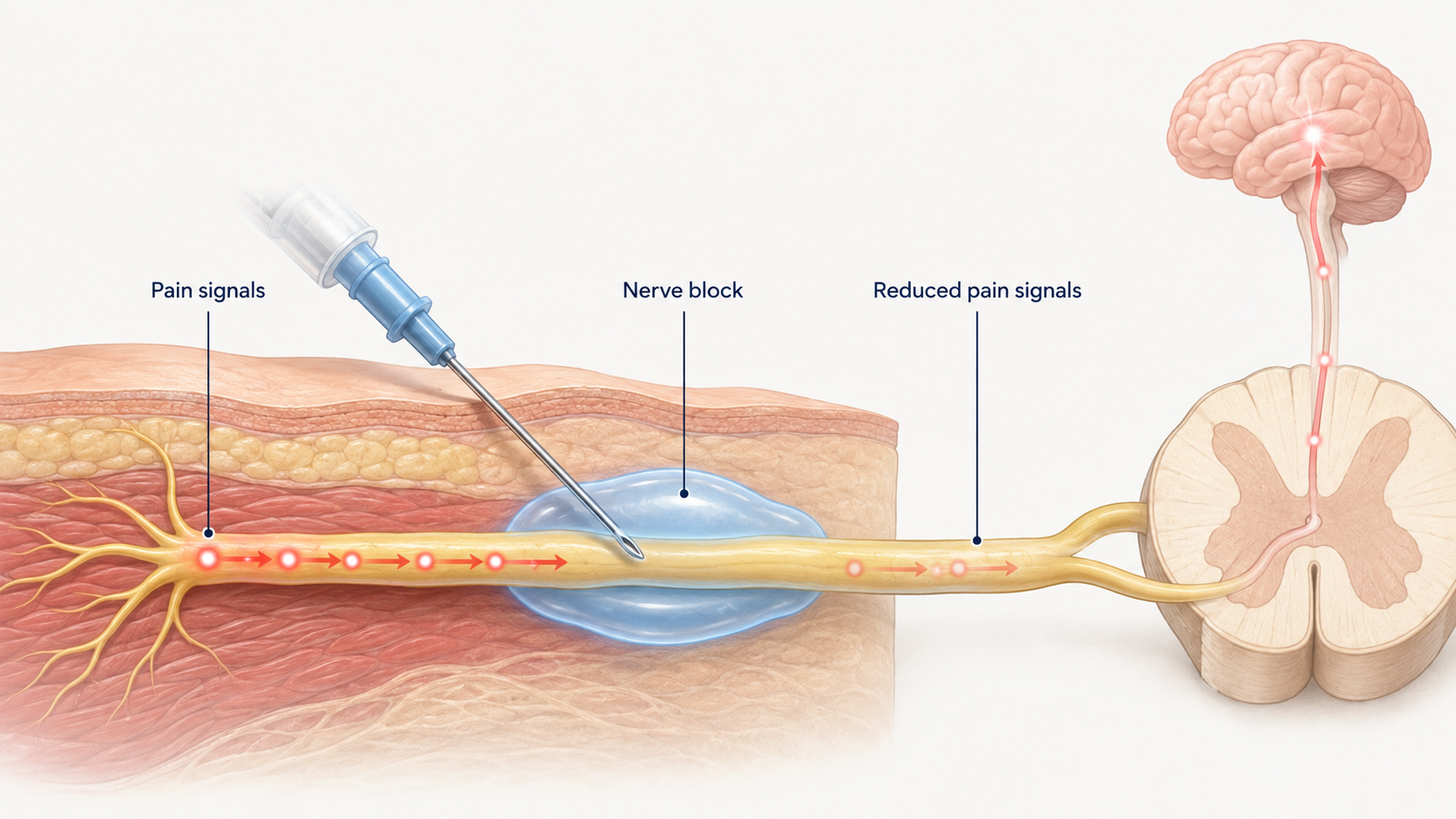
When medication, physiotherapy and other conservative treatments do not provide sufficient relief from chronic pain, a more targeted approach may be considered.
A nerve block involves injecting medication near a specific nerve or group of nerves involved in transmitting pain. Depending on the condition and medication used, it may reduce pain, improve function and make it easier to participate in rehabilitation.
This article explains how nerve blocks work, the conditions they may help treat, the different types available and what to expect from the procedure.
What is a nerve block?
A nerve block is a minimally invasive procedure in which medication is injected near a specific nerve or group of nerves involved in carrying pain signals.
The injection may contain:
- A local anaesthetic — temporarily interrupts the transmission of pain signals through the targeted nerve.
- A corticosteroid — may reduce inflammation around an irritated nerve and provide longer-lasting symptom relief.
- A combination of medications — may be used when both immediate and longer-lasting effects are intended.
Unlike oral medication, which circulates throughout the body, a nerve block directs treatment towards a particular anatomical area. However, the response depends on the condition being treated, and not everyone experiences the same degree or duration of relief.
How do nerve blocks help relieve chronic pain?
Pain signals travel along nerves from an affected part of the body towards the spinal cord and brain. A nerve block places medication near one of these pathways to temporarily reduce the signals being transmitted.
Depending on the procedure and medication used, a nerve block may help by:
- Interrupting pain signals — Local anaesthetics temporarily prevent the targeted nerve from transmitting signals normally.
- Reducing inflammation — Corticosteroids may decrease inflammation around an irritated nerve, although they do not remove structural compression.
- Improving movement and function — Reducing pain may make walking, exercising and everyday activities more manageable.
- Supporting rehabilitation — A period of improved pain control may make it easier to participate in physiotherapy and rebuild movement, strength and confidence.
The aim is not always to eliminate pain completely. In some cases, even partial or temporary relief can support progress with other parts of a pain-management plan.
What conditions may be treated with a nerve block?
Nerve blocks may be considered for selected pain conditions in which a particular nerve or nerve pathway appears to contribute to the symptoms.
These may include:
- Radiating neck or lower-back pain — including selected cases of pain travelling into an arm or leg because of spinal nerve irritation.
- Facet-related neck or back pain — pain suspected to arise from the small joints at the back of the spine.
- Peripheral nerve pain — pain associated with an irritated, compressed or injured nerve in an arm, leg or another part of the body.
- Occipital neuralgia and selected headache disorders — where nerves at the back of the head contribute to pain.
- Complex regional pain syndrome (CRPS) — in selected cases where the sympathetic nervous system may be involved.
- Persistent pain after surgery or injury — when the pain can be linked to a particular nerve or anatomical area.
- Selected joint-related pain — including some forms of persistent shoulder or knee pain where an appropriate sensory nerve can be targeted.
- Cancer-related pain — including certain abdominal, pelvic or other pain patterns that may respond to a targeted nerve or nerve-plexus block.
Having one of these conditions does not automatically mean that a nerve block is appropriate. Your pain specialist will consider the location and pattern of your symptoms, their underlying cause, previous treatments and your overall health.
Types of nerve blocks
Nerve blocks are generally named according to the nerve or anatomical area being treated. The appropriate procedure depends on the suspected source and pattern of pain.
| Type of nerve block | Area targeted | When it may be considered |
| Selective nerve root or dorsal root ganglion block | A spinal nerve root or dorsal root ganglion | Selected cases of pain travelling into an arm or leg due to spinal nerve irritation |
| Peripheral nerve block | A named nerve outside the brain and spinal cord | Selected cases of limb, joint, neuropathic or persistent postsurgical pain |
| Medial branch block | Small nerves supplying the spinal facet joints | Facet-related neck or back pain, sometimes before radiofrequency ablation |
| Occipital nerve block | Greater or lesser occipital nerves at the back of the head | Occipital neuralgia and selected headache disorders |
| Sympathetic nerve block | Part of the sympathetic nervous system | Selected cases of CRPS and sympathetically maintained pain |
| Intercostal nerve block | An intercostal nerve running beneath a rib | Selected cases of rib, chest-wall or persistent post-thoracotomy pain |
| Nerve plexus block | A network of nerves | Certain forms of abdominal, pelvic or cancer-related pain |
What happens during a nerve block procedure?
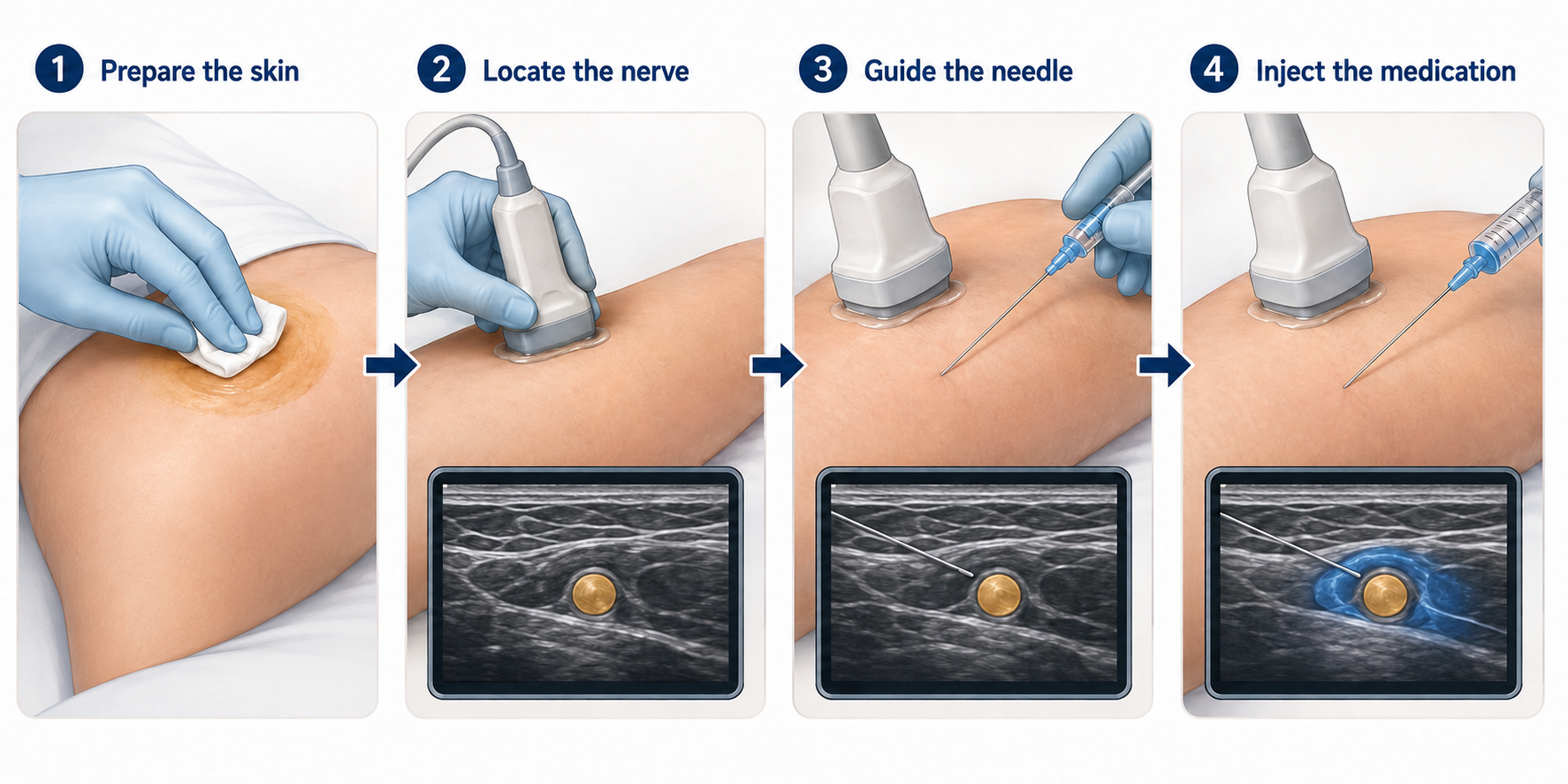
The exact steps depend on the nerve being treated, but the procedure generally involves:
- Positioning — You will be positioned so the doctor can safely reach the intended injection site.
- Skin preparation — The area will be cleaned with an antiseptic solution to reduce the risk of infection.
- Local anaesthetic — A small amount of local anaesthetic may be injected to numb the skin.
- Imaging guidance — Ultrasound or fluoroscopy may be used to identify the target and guide the needle. Ultrasound provides real-time images of nerves and nearby soft tissues without ionising radiation, while fluoroscopy helps visualise bony landmarks during certain spinal procedures.
- Needle placement — A fine needle is carefully advanced towards the targeted area.
- Medication injection — Once the position has been confirmed, the selected medication is injected.
- Observation — The needle is removed, and you will be monitored for an appropriate period before discharge.
Many nerve blocks can be completed within 15 to 30 minutes, although complex procedures may take longer. The total appointment will also include preparation and recovery time.
How long does pain relief from a nerve block last?
There is no single duration that applies to every nerve block.
A local anaesthetic may begin working within minutes and commonly provides relief for several hours. When a corticosteroid is included, its anti-inflammatory effect may take several days to develop and may last longer.
Some patients experience relief for weeks or months, while others obtain only brief, partial or no meaningful improvement. The duration depends on factors such as:
- The nerve and condition being treated
- The medication used
- The severity and duration of the condition
- The individual response to treatment
- Rehabilitation and other treatments used alongside the block
A nerve block may be repeated when clinically appropriate, but the recommended frequency depends on the type of procedure, medication used, previous response and individual risk factors.
Who may be suitable for a nerve block?
A nerve block may be considered if you:
- Have persistent pain that has not improved sufficiently with conservative treatment
- Have symptoms associated with a specific nerve or nerve pathway
- Find that pain is limiting movement, sleep, work or everyday activities
- Need better pain control to participate in physiotherapy or rehabilitation
- Wish to explore a minimally invasive treatment as part of your pain-management plan
Your pain specialist will determine whether the likely benefits justify the risks in your individual case.
Summary
A nerve block is a targeted treatment that may help manage selected forms of chronic pain by interrupting pain signals or reducing inflammation around an irritated nerve.
The type of block recommended depends on the source and pattern of the pain. While some patients experience relief lasting weeks or months, others may have a shorter or more limited response. A nerve block is therefore usually considered as one part of a broader treatment plan rather than a permanent cure.
If persistent pain is affecting your movement, sleep, work or everyday activities, consider scheduling a consultation with Apicare Pain Clinic. Our pain specialist can assess the possible causes of your symptoms and discuss whether a nerve block or another pain-management option may be suitable for you.
Frequently Asked Questions
Is a nerve block the same as a steroid injection?
Not exactly. A nerve block describes a procedure in which medication is placed near a targeted nerve or group of nerves. It may contain a local anaesthetic, a corticosteroid or a combination of medications.
A steroid injection describes the medication being used and may also refer to injections into joints, bursae or other structures rather than around a nerve.
Will I be awake during a nerve block?
Many nerve blocks are performed while the patient is awake. Local anaesthetic may be used to numb the skin, while mild sedation may be offered for selected procedures. This depends on the type of block, your health and whether the doctor needs feedback from you during the procedure.
Is a nerve block painful?
You may feel a brief sting when the skin is numbed, followed by pressure or discomfort as the needle is positioned. The experience varies according to the location of the injection and individual sensitivity.
How quickly will a nerve block work?
A local anaesthetic may begin working within minutes. If a corticosteroid is included, its effects may take several days to develop. The original pain may return after the anaesthetic wears off and before the corticosteroid begins working.
Can I drive after a nerve block?
You may be advised not to drive on the day of the procedure, particularly if sedation was used or the treated area feels numb or weak. Follow the instructions provided for your specific procedure and arrange transport when advised.
How many nerve blocks can I have?
There is no single number suitable for everyone. The decision depends on the procedure, medication, response to previous injections, underlying condition and cumulative risks. Repeat blocks should only be performed when clinically appropriate.
Will I still need physiotherapy after a nerve block?
In many cases, yes. A nerve block may make movement and physiotherapy more comfortable, but rehabilitation may still be needed to improve strength, mobility and function.
What happens if a nerve block does not relieve my pain?
Not everyone responds to a nerve block. If you experience little or no improvement, your pain specialist may reassess the possible source of the pain and discuss whether another treatment approach would be more appropriate.
Can a nerve block permanently cure chronic pain?
Nerve blocks usually provide temporary pain relief rather than permanently correcting the underlying condition. Their role is generally to manage symptoms, improve function and support other parts of the treatment plan.