

At a glance
| Purpose | Relieve pain without surgery |
| Suitable for | Back pain, neck pain, arthritis, nerve pain, sports injuries and more |
| Treatment options | Medications, physiotherapy, lifestyle changes, injections and regenerative medicine |
| Benefits | Pain relief, improved mobility and better quality of life |
| Goal | Restore function and reduce reliance on surgery where appropriate |
Living with persistent pain can affect almost every aspect of daily life, from walking and working to exercising and sleeping. While many people worry that ongoing pain will eventually require surgery, many musculoskeletal, joint and nerve-related conditions can often be effectively managed with non-surgical treatments that relieve pain, improve function and support long-term recovery.
Non-surgical pain management takes a personalised approach based on the underlying cause of pain, its severity, your lifestyle and treatment goals. Depending on your condition, management may involve medications, physiotherapy, lifestyle modifications and minimally invasive pain procedures working together to improve mobility, restore function and enhance quality of life.
This guide explains what non-surgical pain management involves, the conditions it can help treat, the treatment options available and when it may be appropriate to seek assessment from a pain specialist.
What is non-surgical pain management?
Non-surgical pain management is a comprehensive approach to diagnosing, treating and controlling pain without the need for surgery [1]. Rather than focusing solely on relieving symptoms, it aims to identify and address the underlying cause of pain while improving physical function, mobility and overall quality of life. Treatment is often personalised and may involve a combination of medications, physiotherapy, lifestyle modifications, psychological support and minimally invasive pain procedures, depending on the patient’s condition and individual needs.
For many people, non-surgical pain management can effectively reduce pain, restore function and delay or even eliminate the need for surgery. Even when surgery is ultimately required, conservative pain management often plays an important role before and after an operation to optimise recovery and improve long-term outcomes.
What are the goals of non-surgical pain management?
The primary goal of non-surgical pain management is not simply to make pain disappear, but to help patients regain control over their daily lives. Effective treatment aims to reduce pain intensity while improving physical function, enabling patients to work, exercise, sleep more comfortably and participate in activities they enjoy.
Depending on the underlying condition, non-surgical pain management may also help:
- Reduce inflammation and irritation contributing to pain
- Improve joint mobility, flexibility and muscle strength
- Enhance independence in everyday activities
- Prevent acute pain from developing into chronic pain where possible
- Minimise reliance on long-term pain medications, particularly opioids
- Improve emotional well-being and overall quality of life
Because pain affects every individual differently, treatment goals are tailored to each patient’s symptoms, lifestyle, medical history and personal priorities.
What is the difference between acute and chronic pain?
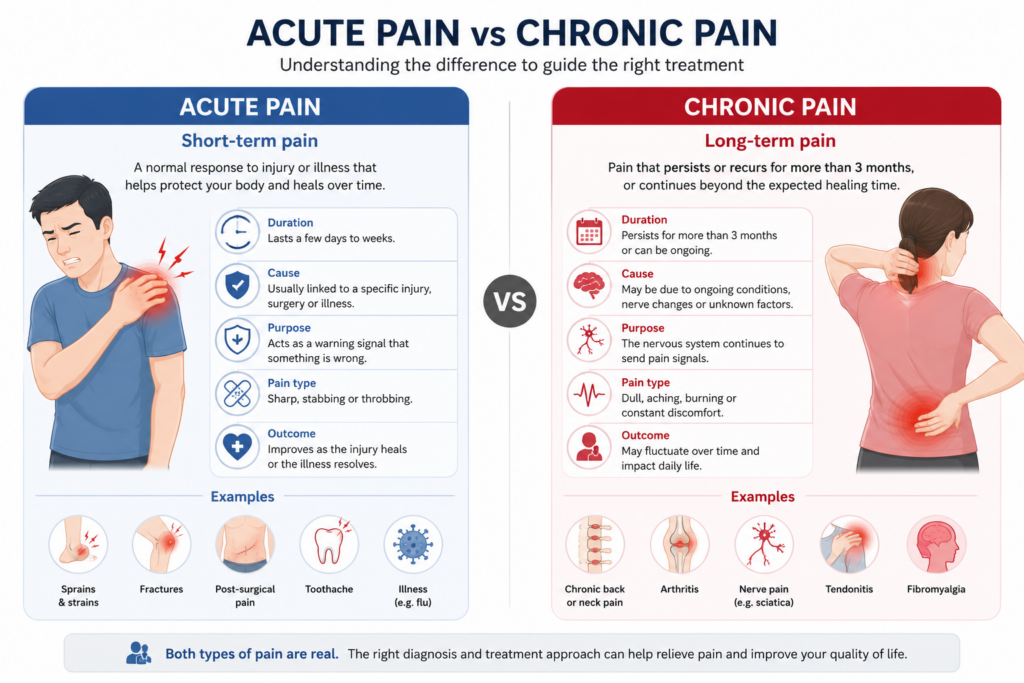
Understanding whether pain is acute or chronic helps guide the most appropriate treatment approach.
- Acute pain — Acute pain is short-term pain that usually develops suddenly following an injury, surgery or illness [2]. It serves as the body’s natural warning signal that tissue damage has occurred and generally improves as healing takes place. Examples include pain from a sprained ankle, muscle strain, fracture or recent surgical procedure.
- Chronic pain — It is the pain that persists or recurs for more than three months, or continues beyond the expected period of tissue healing [3]. It may result from ongoing conditions such as arthritis, degenerative spinal disorders or nerve damage, but in some cases, pain continues even after the original injury has healed due to changes in how the nervous system processes pain signals.
Which conditions can be treated without surgery?
Many painful conditions do not require surgery and can often be successfully managed with a combination of conservative treatments. The most appropriate approach depends on the underlying cause, severity of symptoms, duration of pain and how the condition affects a person’s daily life.
In many cases, early non-surgical intervention can relieve symptoms, improve function and help patients avoid or postpone surgery.
Some of the conditions that may benefit from non-surgical pain management include:
- Back pain — Including acute and chronic lower back pain, mechanical back pain and degenerative spinal conditions.
- Neck pain — Pain arising from muscle strain, poor posture, cervical spondylosis or degenerative changes in the cervical spine.
- Sciatica — Pain caused by irritation or compression of the sciatic nerve, often radiating from the lower back into the buttock and leg.
- Arthritis — Including osteoarthritis and other forms of joint degeneration that cause pain, stiffness and reduced mobility.
- Joint pain — Persistent pain affecting joints such as the shoulders, hips, knees, wrists or ankles.
- Shoulder pain — Conditions such as rotator cuff disorders, shoulder impingement, frozen shoulder and bursitis.
- Knee pain — Pain resulting from osteoarthritis, ligament injuries, meniscal injuries, tendinopathy or overuse.
- Hip pain — Pain associated with osteoarthritis, bursitis, tendon disorders or other musculoskeletal conditions affecting the hip.
- Tendon injuries — Including tendinitis and tendinopathy involving the shoulder, elbow, wrist, hip, knee or ankle.
- Sports injuries — Muscle strains, ligament sprains, overuse injuries and other musculoskeletal conditions sustained during physical activity.
- Nerve pain — Pain caused by irritation, compression or injury to peripheral nerves.
- Neuropathic pain — Chronic pain resulting from damage or dysfunction of the nervous system, such as diabetic neuropathy or post-herpetic neuralgia.
- Myofascial pain syndrome — A chronic pain condition characterised by sensitive trigger points within muscles and surrounding connective tissues.
- Fibromyalgia — A long-term condition associated with widespread musculoskeletal pain, fatigue and tenderness throughout the body.
- Cancer-related pain — Pain resulting from cancer itself or its treatment, where pain specialists play an important role in improving comfort and quality of life alongside cancer care.
- Post-operative pain — Persistent pain following surgery that may require specialised pain management to support recovery and rehabilitation.
- Chronic headaches — Certain headache disorders, including some chronic migraines and occipital neuralgia, may be managed by pain specialists as part of a comprehensive treatment plan.
It is important to note that non-surgical pain management is not always appropriate for every condition. Some patients may have significant structural damage, progressive neurological symptoms or advanced joint disease where surgery offers the most appropriate treatment. Following a comprehensive assessment, your pain specialist will recommend the most suitable management approach, which may include referral for surgical evaluation when indicated.

What are the main non-surgical pain management treatment options?
Non-surgical pain management encompasses a range of treatments designed to reduce pain, improve function and enhance quality of life without the need for surgery. Pain specialists often combine several treatment approaches to address the underlying cause of pain while improving function and quality of life. The most appropriate combination depends on the cause of pain, its severity, duration and the patient’s treatment goals.
For some patients, simple conservative measures may be sufficient to relieve symptoms. Others, particularly those with persistent or complex pain, may benefit from a multidisciplinary approach that addresses both the physical and psychological aspects of pain. By combining different treatment strategies, many patients experience better long-term outcomes than with a single treatment alone.
The main non-surgical pain management treatment options include:
Medications
Medications are often used to help relieve pain, reduce inflammation and improve comfort, allowing patients to participate more effectively in rehabilitation and daily activities. The choice of medication depends on the type and cause of pain, as different medications work best for different conditions.
Commonly prescribed medications may include:
- Simple analgesics — Such as paracetamol for mild to moderate pain [4].
- Non-steroidal anti-inflammatory drugs (NSAIDs) — To reduce pain and inflammation [5] associated with conditions such as arthritis, tendon injuries and musculoskeletal pain.
- Muscle relaxants — For selected patients experiencing muscle spasms contributing to pain [6].
- Neuropathic pain medications — Certain antidepressants and anticonvulsants may be prescribed to help manage nerve-related pain by altering how pain signals are processed within the nervous system [7].
- Topical medications — Creams, gels or medicated patches that provide localised pain relief with fewer systemic side effects [8].
- Opioids — These medications may be considered for carefully selected patients with severe pain when other treatments have not been effective [9]. However, due to the risks of dependence, tolerance and side effects, they are generally prescribed at the lowest effective dose for the shortest appropriate duration under close medical supervision.
While medications can provide important symptom relief, they are typically most effective when used alongside other non-surgical treatments rather than as a long-term standalone solution.
Physiotherapy
Physiotherapy plays a central role in non-surgical pain management by addressing the underlying mechanical and functional causes of pain rather than simply relieving symptoms. Through targeted rehabilitation, physiotherapy helps restore movement, improve strength and flexibility, reduce stiffness and support long-term recovery.
A physiotherapy programme may include:
- Individualised strengthening exercises
- Stretching and flexibility training
- Mobility and range-of-motion exercises
- Postural correction
- Manual therapy techniques
- Balance and functional movement training
- Home exercise programmes to maintain long-term progress
Regular participation in physiotherapy can improve physical function, reduce the risk of recurrent injuries and help patients regain confidence in performing everyday activities.

Lifestyle changes
Lifestyle modifications are an important component of long-term pain management, particularly for chronic musculoskeletal conditions. Healthy daily habits can reduce stress on the body, support tissue healing and help minimise future pain flare-ups.
Depending on the individual’s condition, recommended lifestyle changes may include:
- Maintaining regular physical activity within comfortable limits
- Achieving and maintaining a healthy weight to reduce stress on the joints and spine
- Improving sleep quality, as poor sleep can increase pain sensitivity
- Managing stress through relaxation techniques, mindfulness or other coping strategies
- Following a balanced diet that supports overall health
- Stopping smoking, as smoking may impair healing and worsen certain pain conditions
- Improving workplace and home ergonomics to reduce repetitive strain and poor posture
Although lifestyle changes may take time to produce noticeable improvements, they often form the foundation of sustainable, long-term pain management and complement other treatments such as medications, physiotherapy and minimally invasive procedures.
What minimally invasive pain procedures are available?
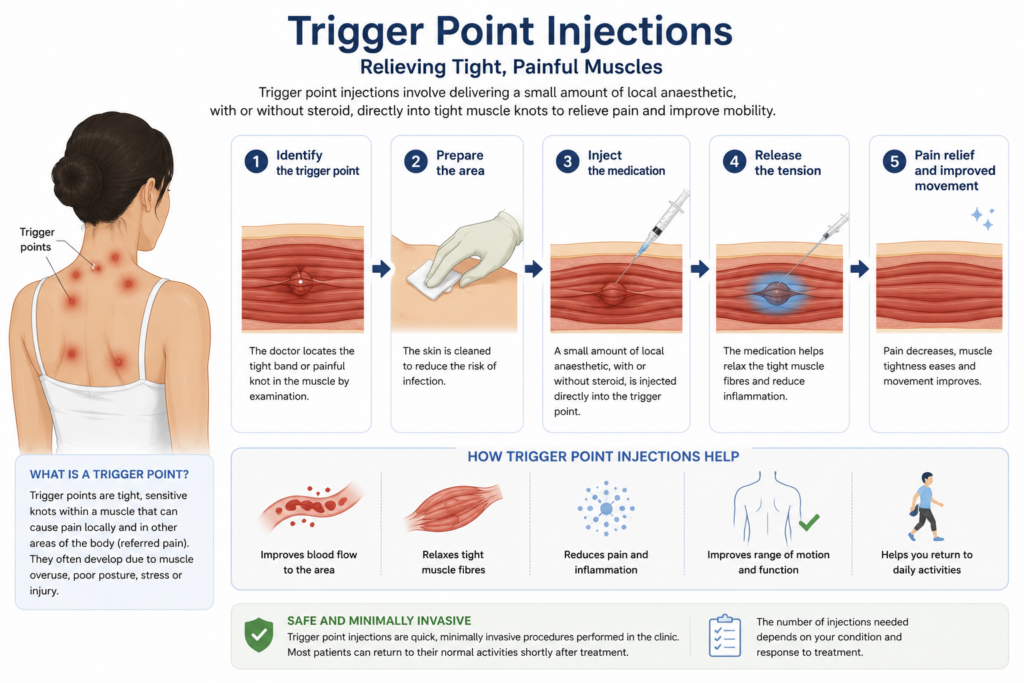
When pain does not improve adequately with medications, physiotherapy and lifestyle changes, minimally invasive procedures may be considered. These treatments are usually performed through small needles rather than open surgery and are designed to target specific pain sources, such as inflamed joints, irritated nerves, muscle trigger points or spinal structures.
Depending on the condition, they may help reduce inflammation, interrupt pain signals, improve mobility and support rehabilitation.
| Trigger point injections | Trigger point injections may be used for myofascial pain, where tight, sensitive knots within muscles contribute to local or referred pain. A small amount of medication is injected directly into the trigger point to help relax the muscle, reduce pain and improve movement. |
| Joint injections | Joint injections involve placing medication directly into a painful joint, such as the knee, hip, shoulder or small spinal joints. They may help reduce inflammation and pain caused by arthritis, injury or joint irritation. |
| Epidural steroid injections | Epidural steroid injections deliver anti-inflammatory medication into the epidural space around the spinal nerves. They are commonly used for conditions such as sciatica, slipped discs or spinal stenosis, where inflamed or compressed nerves cause pain travelling into the arms or legs. |
| Nerve root blocks | A nerve root block targets a specific spinal nerve that is believed to be causing pain. It may be used both diagnostically, to identify the source of pain, and therapeutically, to reduce nerve irritation and radiating symptoms. |
| Facet joint injections | Facet joint injections target the small joints at the back of the spine, which can become painful due to arthritis, degeneration or injury [10]. These injections may help relieve neck or back pain arising from facet joint inflammation. |
| Medial branch blocks | Medial branch blocks involve injecting local anaesthetic near the small nerves that supply the facet joints [11]. They are often used to confirm whether facet joints are the source of pain and may help determine whether radiofrequency ablation is suitable. |
| Radiofrequency ablation | Radiofrequency ablation uses controlled heat energy to treat selected pain-transmitting nerves. It may provide longer-lasting pain relief for certain patients with facet joint pain, sacroiliac joint pain or other nerve-mediated pain conditions. |
| Sacroiliac joint injections | Sacroiliac joint injections target the joint between the lower spine and pelvis [12]. They may be recommended when sacroiliac joint inflammation or dysfunction causes lower back, buttock or hip-region pain. |
| Sympathetic nerve blocks | Sympathetic nerve blocks target part of the sympathetic nervous system and may be considered for selected nerve-related pain conditions, such as complex regional pain syndrome or certain types of chronic limb pain [13]. |
| Ultrasound-guided injections | Ultrasound guidance allows the doctor to visualise muscles, tendons, joints and surrounding structures during an injection. This can improve accuracy, especially for soft tissue, tendon and peripheral joint procedures. |
What is regenerative medicine for pain management?
Regenerative medicine is an area of pain management that aims to support the body’s natural healing response, particularly in selected tendon, ligament and joint conditions. Instead of only reducing inflammation or blocking pain signals, regenerative treatments are intended to encourage tissue repair and improve function.
However, suitability depends on the diagnosis, severity of tissue damage and available clinical evidence.
- Platelet-rich plasma (PRP) — Platelet-rich plasma, or PRP, involves taking a small sample of the patient’s blood, processing it to concentrate the platelets, and injecting it into the affected area. Platelets contain growth factors that may support healing in selected conditions such as tendinopathy, ligament injuries or early joint degeneration.
- Prolotherapy — Prolotherapy involves injecting an irritant solution, commonly dextrose-based, into painful ligaments, tendons or joints to stimulate a healing response [14]. It may be considered for selected patients with chronic soft tissue or joint-related pain, although availability and suitability vary between clinics.
Why choose non-surgical pain management before surgery?
While surgery may be the most appropriate treatment for certain conditions, it is not always the first or only option. Many musculoskeletal, joint and nerve-related conditions can often be effectively managed without an operation, particularly when they are identified early or have not caused significant structural damage.
Non-surgical pain management aims to relieve pain, improve movement and restore function while avoiding the risks, recovery time and potential complications associated with surgery. For many patients, a personalised combination of medications, physiotherapy, lifestyle modifications and minimally invasive pain procedures can provide meaningful symptom relief and improve quality of life.
Even if surgery is eventually required, conservative pain management often remains an important part of treatment. Improving strength, mobility and overall physical function before surgery may support recovery afterwards, while ongoing rehabilitation and pain management continue to play an important role during the postoperative period.
Potential benefits of non-surgical pain management include:
- Relieves pain without surgery
- Reduces the risk of complications associated with surgery
- Shortens recovery time and minimises downtime
- Improves mobility and physical function
- Provides personalised treatment based on the underlying condition
- May delay or avoid the need for surgery in suitable patients
- Supports recovery before and after surgery when an operation is required
Is non-surgical pain management effective?
Non-surgical pain management can be effective for many patients, especially when treatment is based on an accurate diagnosis and tailored to the individual. Pain is often influenced by several factors, including inflammation, nerve irritation, muscle weakness, joint degeneration, posture, lifestyle and emotional stress. For this reason, the most effective treatment plans usually combine different approaches rather than relying on one method alone.
Early intervention can also improve outcomes. Addressing pain before it becomes persistent may help reduce the risk of long-term disability, movement avoidance and worsening physical function. For chronic pain, treatment may focus on reducing flare-ups, improving mobility, restoring confidence and helping patients return to daily activities.
It is important to set realistic expectations. In some cases, complete pain elimination may not be possible, particularly with long-standing degenerative or nerve-related conditions. However, meaningful improvement is still achievable. For many patients, the main goal is to reduce pain to a manageable level, improve function, increase independence and enhance quality of life without surgery.
When should you see a pain specialist?
While many episodes of pain improve with rest, self-care and conservative treatment, persistent or worsening symptoms should not be ignored. A pain specialist can identify the underlying cause of your pain, recommend appropriate investigations where necessary and develop an individualised treatment plan aimed at improving both pain and function.
You should consider seeing a pain specialist if you experience:
- Pain lasting longer than three months — Pain that persists beyond the expected healing period may indicate chronic pain requiring specialised assessment and management.
- Pain that interferes with sleep — Ongoing pain that disrupts your sleep can affect physical recovery, mental well-being and overall quality of life.
- Difficulty walking, working or performing daily activities — Pain that limits your mobility or ability to carry out everyday tasks should be evaluated promptly.
- Pain that does not improve with conservative treatment — If over-the-counter pain relief, prescribed medications or physiotherapy have not provided sufficient relief, further assessment may be beneficial.
- Recurrent pain flare-ups — Pain that repeatedly returns despite treatment may suggest an underlying condition that requires a more comprehensive management approach.
- An unclear diagnosis — If the cause of your pain remains uncertain despite previous medical assessments, a pain specialist can perform a detailed evaluation and recommend further investigations if appropriate.
- Persistent nerve pain — Symptoms such as burning pain, tingling, numbness, electric shock-like sensations or pain radiating into the arms or legs may indicate nerve involvement and should be assessed by a specialist.
Seeking treatment early may help prevent pain from becoming more persistent and difficult to manage, while allowing you to return to your normal activities sooner.
Conclusion
Non-surgical pain management offers a comprehensive approach to treating many painful conditions without the need for surgery. Instead of relying on a single treatment, effective pain management often combines medications, physiotherapy, lifestyle modifications and, where appropriate, minimally invasive interventional procedures to address the underlying cause of pain while improving mobility, function and quality of life.
Because every patient’s condition and treatment goals are unique, an individualised management plan is essential. Early assessment and timely intervention can help prevent pain from becoming chronic, reduce the risk of long-term disability and support better long-term outcomes.
If persistent pain is affecting your daily activities, work or quality of life, consult a pain specialist for an accurate diagnosis and a personalised treatment plan tailored to your needs.
Frequently Asked Questions (FAQs)
Can chronic pain be treated without surgery?
Yes. Many chronic pain conditions can be effectively managed without surgery through a combination of medications, physiotherapy, lifestyle modifications and minimally invasive pain procedures. The most appropriate treatment depends on the underlying cause of the pain and the individual’s overall health.
Is non-surgical pain management safe?
Non-surgical pain management is generally safe when recommended and supervised by a qualified healthcare professional. As with any medical treatment, each option has potential benefits and risks, which should be discussed with your doctor before treatment begins.
How long does non-surgical pain treatment take to work?
The timeframe varies depending on the condition and treatment used. Some patients experience relief within days after certain medications or injections, while improvements from physiotherapy, rehabilitation and lifestyle changes may develop gradually over several weeks or months.
Can I avoid surgery with pain management?
In many cases, yes. Appropriate non-surgical treatment can relieve symptoms, improve function and delay or even eliminate the need for surgery. However, some conditions may still require surgery if conservative treatment is unsuccessful or if there is significant structural damage or neurological compromise.
Are pain injections painful?
Most pain injections cause only mild discomfort. Local anaesthetic is often used to minimise pain during the procedure, and many injections are performed under ultrasound or imaging guidance to improve accuracy and patient comfort.
Do I need imaging before seeing a pain specialist?
Not always. A pain specialist will first perform a thorough medical history and physical examination. Imaging studies such as X-rays, ultrasound, CT scans or MRI scans may only be recommended if they are necessary to confirm the diagnosis or guide treatment.
What is the difference between a pain specialist and an orthopaedic surgeon?
A pain specialist focuses on diagnosing and managing pain using non-surgical treatments, medications, rehabilitation strategies and minimally invasive procedures. An orthopaedic surgeon specialises in diagnosing and surgically treating conditions affecting the bones, joints, muscles and ligaments when an operation is indicated.
Can non-surgical treatments help arthritis pain?
Yes. Many patients with arthritis benefit from non-surgical treatments such as physiotherapy, medications, weight management, activity modification and image-guided joint injections, which can help reduce pain and improve joint function.
Does health insurance cover non-surgical pain management?
Insurance coverage varies depending on your insurer, policy and the specific treatments provided. It is advisable to check with your insurance provider or the clinic beforehand to understand your available benefits and any applicable exclusions.
Are pain injections a permanent solution?
Pain injections are intended to reduce pain and inflammation so that patients can participate more effectively in rehabilitation and daily activities. The duration of pain relief varies depending on the underlying condition, and injections are often used as part of a broader treatment plan rather than a standalone long-term solution.
Can I exercise if I have chronic pain?
Patients often worry that movement will make their pain worse. Depending on the underlying condition, appropriate exercise and physiotherapy are often encouraged to improve strength, flexibility and function. Your doctor or physiotherapist can recommend activities that are safe and suitable for your condition.
References
- Jo, D. (2024). A comprehensive overview and scope of interventional pain management. The Korean Journal of Pain, 37(2), 89–90. https://doi.org/10.3344/kjp.24076
- Grichnik, K. P., & Ferrante, F. M. (1991). The difference between acute and chronic pain. The Mount Sinai Journal of Medicine, New York, 58(3), 217–220.
- Stretanski, M. F., Kopitnik, N. L., Matha, A., & Conermann, T. (2026). Chronic pain. In StatPearls. StatPearls Publishing. http://www.ncbi.nlm.nih.gov/books/NBK553030/
- Queremel Milani, D. A., & Davis, D. D. (2026). Pain management medications. In StatPearls. StatPearls Publishing. http://www.ncbi.nlm.nih.gov/books/NBK560692/
- Ghlichloo, I., & Gerriets, V. (2026). Nonsteroidal anti-inflammatory drugs(Nsaids). In StatPearls. StatPearls Publishing. http://www.ncbi.nlm.nih.gov/books/NBK547742/
- Witenko, C., Moorman-Li, R., Motycka, C., Duane, K., Hincapie-Castillo, J., Leonard, P., & Valaer, C. (2014). Considerations for the appropriate use of skeletal muscle relaxants for the management of acute low back pain. Pharmacy and Therapeutics, 39(6), 427–435. https://www.ncbi.nlm.nih.gov/pmc/articles/PMC4103716/
- Mian, M. U., Afzal, M., Butt, A. A., Ijaz, M., Khalil, K., Abbasi, M., Fatima, M., Asif, M., Nadeem, S., Jha, S., & Panjiyar, B. K. (n.d.). Neuropharmacology of neuropathic pain: A systematic review. Cureus, 16(9), e69028. https://doi.org/10.7759/cureus.69028
- Sisignano, M., Rice, A. S. C., & Geisslinger, G. (2025). Topical analgesics: Pharmacology and clinical applications. Anesthesiology, 143(5), 1371–1381. https://doi.org/10.1097/ALN.0000000000005579
- Kopitnik, N. L., & Huecker, M. R. (2026). Opioid prescribing. In StatPearls. StatPearls Publishing. http://www.ncbi.nlm.nih.gov/books/NBK551720/
- Won, H.-S., Yang, M., & Kim, Y.-D. (2020). Facet joint injections for management of low back pain: A clinically focused review. Anesthesia and Pain Medicine, 15(1), 8–18. https://doi.org/10.17085/apm.2020.15.1.8
- Mehta, Y., DO, & Peer-Reviewed, P. (2006, April 25). Medial branch nerve blocks. https://www.spine-health.com/treatment/injections/medial-branch-nerve-blocks
- Li, D., Tafti, D., & Varacallo, M. A. (2026). Sacroiliac joint injection. In StatPearls. StatPearls Publishing. http://www.ncbi.nlm.nih.gov/books/NBK513245/
- Gungor, S., Aiyer, R., & Baykoca, B. (2018). Sympathetic blocks for the treatment of complex regional pain syndrome. Medicine, 97(19), e0705. https://doi.org/10.1097/MD.0000000000010705
- Hauser, R. A., Lackner, J. B., Steilen-Matias, D., & Harris, D. K. (2016). A systematic review of dextrose prolotherapy for chronic musculoskeletal pain. Clinical Medicine Insights. Arthritis and Musculoskeletal Disorders, 9, 139–159. https://doi.org/10.4137/CMAMD.S39160